Monday, November 21, 2011

Pine Marina Hotel - Kusadasi

Kusadasi the city is usually a nice summer resort town. It is November, so it's low season and not too many people are around town. Our hotel is situated on the side of a hill, so there is a nice view of the marina from most of the rooms. Our first hotel room was a double bed/twin bed combo (again!), with a balcony and small view of the water. However, we only stayed there one night as our toilet was leaking into the room below. So we were moved to the 5th floor, to a double room, with a balcony that also looked over the marina, but without a house in the way. The decorations were nicer, the rug was nicer, in all it was newly renovated whereas our first room looked rather drab (it had a big yellow design on the rug that at first glance looked like spilled food or drink, or a stain). Lucky for us, the weather during the day got up to 60, so we could open our balcony door and let in some nice air.

The hotel itself looks like it was built in the 70s and is slowly renovating. The reception area has mirrors everywhere and ugly, shiny purple mosaics on the plant vases. But the cocktail area is very nice with couches and chairs, and the dining room looks like any normal hotel dining room.

This hotel also offers free breakfast AND free dinner with your stay. The breakfast is fine: eggs, cheese, veggies, meat, bread, tea or coffee. The dinner is actually quite good; usually a soup, a salad bar, a cold plate bar (mezes/tapas-style), five hot dishes (rice, potato, veggies, and two meats), bread bar, and an assortment of dessert. Drinks are extra. One night we were here, there weren't enough guests to warrant a buffet dinner, so it was served to us in courses by the waiter.

We don't know if there is a beach nearby. We went wandering one night but only found cafes on the sea-front. There is a pool but it's only open during the summer months. In all, it's a fine hotel, especially if you get one of their newer rooms.

View from our window - sunset and at night

Saturday, November 19, 2011

Lost Yer Marble

Ephesus is a very famous ancient city. Anyone who has spent a significant amount of time inside a Christian church probably knows about Paul's letter to the Ephesians. This is the city the letter was sent to. There were three different Ephesuses, but only the remains of the third city can be seen. The marble that was used to build the first city of Ephesus was taken to build the second. When the second city was destroyed the marble from that city was used to build the third city. It makes sense, because marble was and is very expensive. The third city was built during the Roman period around 100BC. It became one of the largest cities in the Mediterranean with a population of around 250,000. The third city was finally destroyed by a giant earthquake in the 7th century AD. After that, the city was conquered by the Seljuk Turks in 1090, which ended Byzantine rule. It was reduced to a small village by the time the second Crusade happened.

The first stop we made was at the house of the Virgin Mary about 7KM away from the Ephesus excavation site. It is believed to be the last place Mary lived before her death. There is no way to confirm this, but John the Baptist was known to have lived in Ephesus. If stories are to be believed, then John took care of Mary after the death of Jesus, which means that she would have lived in Ephesus with him. Now, it has become a place of worship. Daily prayer is held outside the home. Inside the home, no photography is allowed, but there is a statue of Mary. There are also a few relics left by Pope John Paul and Pope Benedictine on their visits to Ephesus.


The house of Mary


A prayer wall

Today, around 20% of the third Ephesus has been excavated. The proper city of Ephesus is being slowly uncovered, but what they have already dug up takes around two hours to walk through. They have figured out a basic layout of the city. They have located the entrance gate, the bathhouse next to it, and the temple of Hestia near the hospital. They have also uncovered the Library of Celsus, which is the third largest library of the ancient world behind Alexandria and Pergamon. Next to the library, they found the “love house,” which apparently is connected to the library by a secret tunnel. The main road, Hercules Gate, and an extremely large amphitheater have also been excavated. You can see where the city walls were, but they are on top of very tall hills. Hopefully, they will finish excavating the site, and you will be able to see the entire ancient city of Ephesus. That would turn a two hour tour into at least a five or six hour tour. Possibly needing a day to itself.


A view of the area Ephesus used to cover


Small amphitheater for nobles


The hospital. Represented by the snake, just like today.


Hermes


A relief of the goddess of victory: Nike


The road to the library


The main road. Emily looks like she's in pain, because the sun was very bright.


Everything was made of marble, so mosaics in front of the houses were used as a show of wealth.


A relief of Medusa. It is the only example from the ancient world where you can see Medusa's body, not just her head.


Shitters for rich people. Apparently, in the winter, they had "seat warmers." A slave would sit on the ice cold marble to warm it up for their master. That job would have been horrible.


The library

Two advertisements for very different things. The one on the left is for the "love house." It basically says, if you have a broken heart and money, walk this way, and you will see beautiful women. The one on the right was a marker letting Christians know that other Christians are present. Early in Christian history, they were a radical sect of Judaism, so it wasn't always safe to be Christian. This was to let them know there were friends in the area.


Inside the main amphitheater and a wide view of the amphitheater


The road to what used to be the harbor is behind us.

After lunch, we were taken to a leather shop. This area of Turkey is known for exceptional leather goods. The fashion show was hilarious. The female models looked like they were bored. They had probably done the same show at least half a dozen times that day. The leather itself was high quality, but the prices on the tags were inflated to the point that the “special” 50% discount made the cost just as high as anything brand new.

The next stop was a museum where many of the statues and everyday objects from the Ephesus excavation site have been put on display. A lot of the things were very interesting, but the museum was filled with loud school children there on a Saturday field-trip. They didn't exactly set the atmosphere for museum viewing. Still, you could get close to the statues and reliefs and see great detail in the work. By this point, everyone was getting a little tired though. Most of us had woken up early, and one group had taken a flight from Istanbul at 7AM for a day tour. They were getting back on a plane after the tour. It didn't help that they went out and drank a little too much raki (an anise liquor similar to Greek ouzo) the night before.


The reliefs from one of the temples and a closeup.

Our final stop of the tour was the once great temple of Artemis. It is one of the seven wonders of the ancient world, because of its size (100 meters long, 60 meters across, and 19 meters high) and the fact that it was the first marble temple. Today, all that remains are a bunch of marble stones and one column made using mismatched stones that they could piece together to show how tall it was. The rest of the temple was “recycled” as our guide put it, to build other structures in the area. Honestly, the temple of Apollo at Didyma was much more impressive, and it is still at least partially in tact. Unfortunately, it was never finished


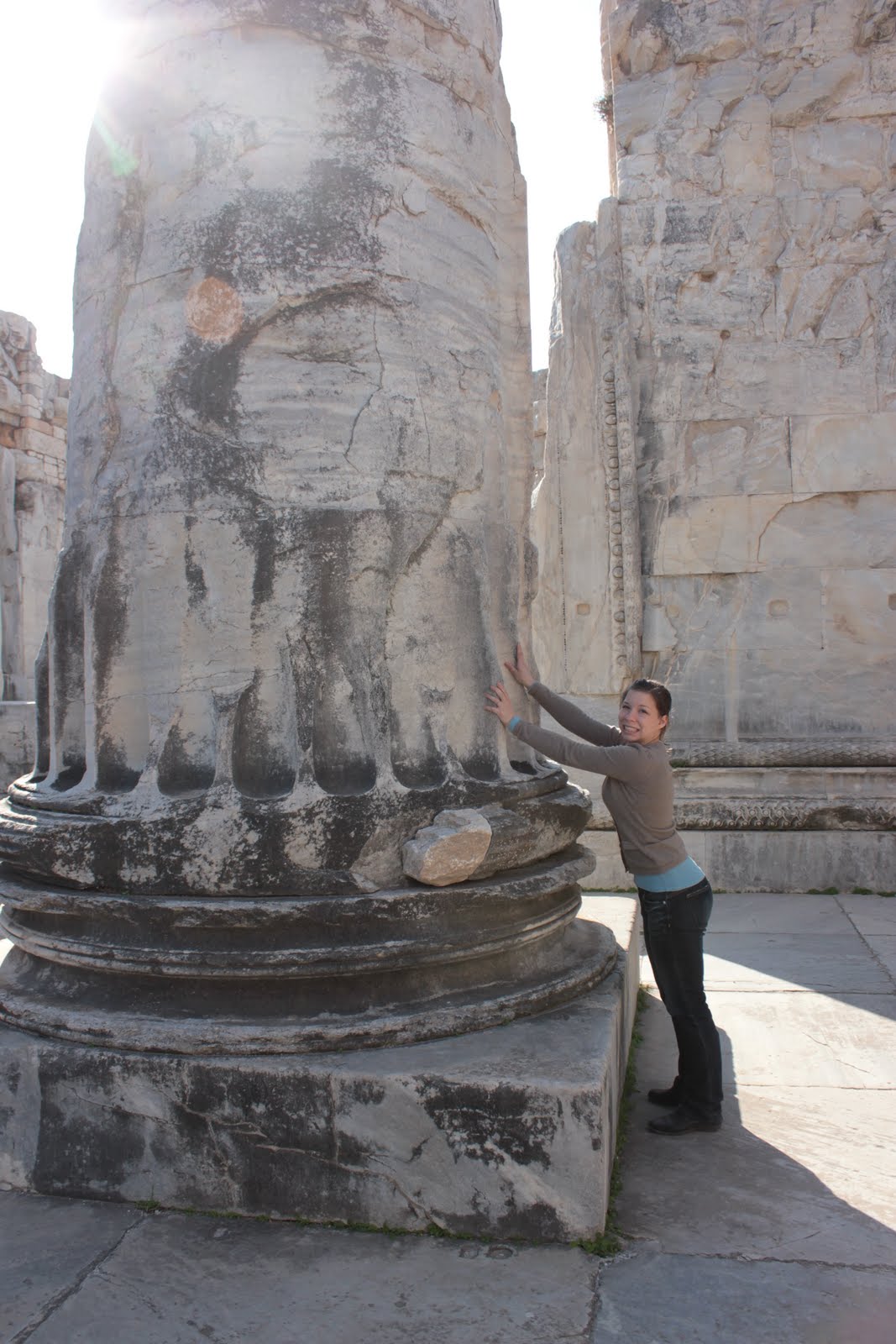
Emily once again showing how tiny she is.

We Three Cities

Today we visited three cities of ruins: Priene, Miletos, and Didyma. They were all different and very memorable. From our hotel in Kusadasi, we were picked up and drove to the first site, Priene.
Priene is a city built on top of a hill in 400BC. At that time, the surrounding flat country-side was water, so in reality the city was built near a harbor area. But over time erosion deposited silt and soil and filled in the area between mountains. Now there are farms and small villages in the area.
Priene began as an independent, Ionian Greek city-state in the 4th C BC, and was conquered by Alexander the Great, the Persians, then the Romans (who became the Byzantines), and finally was abandoned around 1100AD. The most prominent parts of the ruins are the temple of Athena, with five columns still standing, the theater, a gymnasium that was converted into a Basilica during Byzantine times, and the main street with ruins of houses. The city is surrounded by a wall with an acropolis looming over the city. Apparently only 2% of the ruins have been excavated.


View of the acropolis


Amphitheater


Backstage and a VIP seat at the theater


Gymnasium that was turned into a basilica


Temple of Athena
The city was constructed in a grid pattern and used terracotta pipes for sewage systems and heating systems. It's incredible to look out at the surrounding countryside and think it used to be water, and that this marble city flourished on top of such a big hill.


Looking out beyond the temple

Ruins of houses and another temple
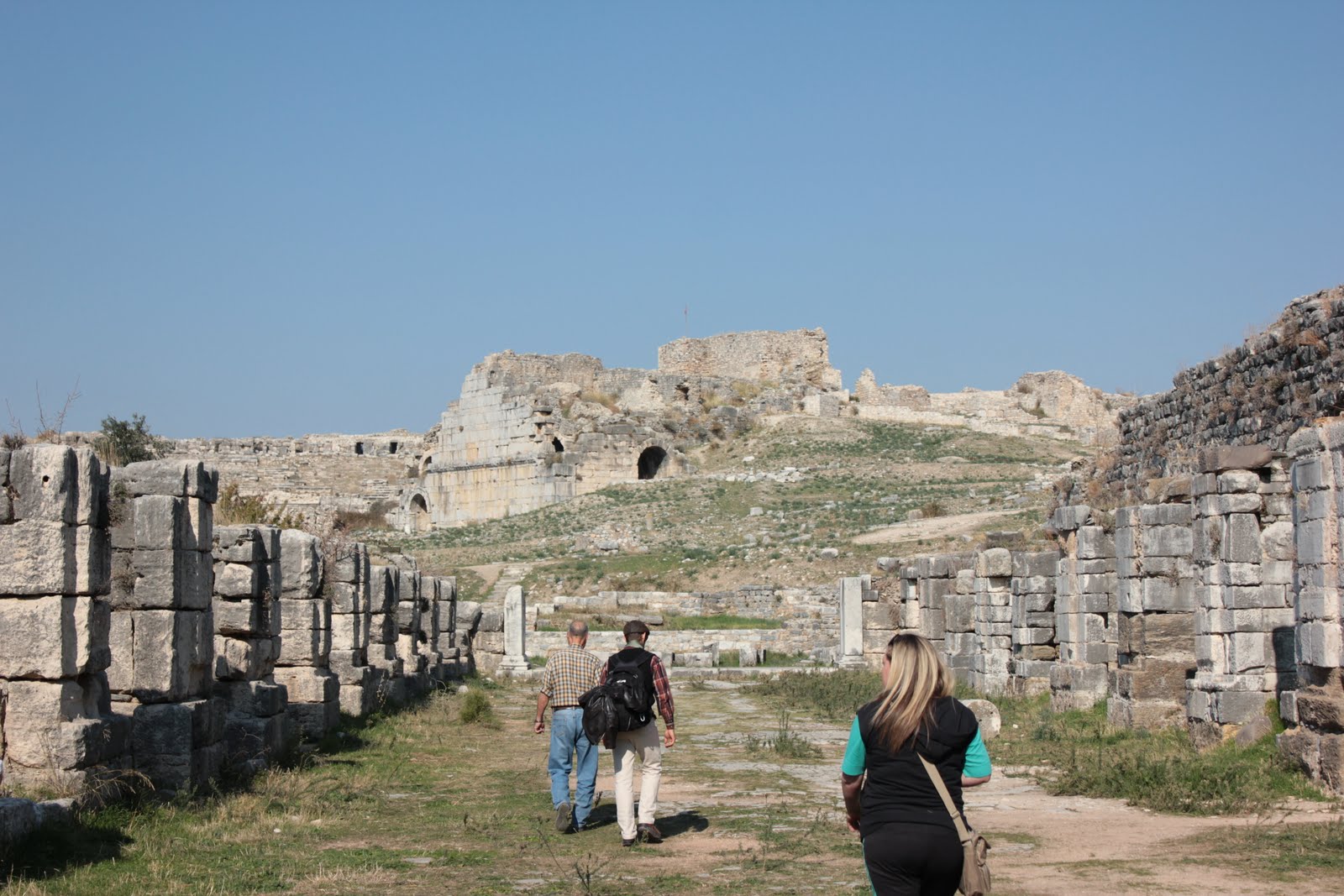
Miletus was the next ruins we visited. As you drive up to the location, you notice a large stone wall. When you finally arrive, you can see that it's actually the backside of a giant amphitheater that has been excavated. According to wikipedia, Miletus existed as far back as Neolithic time, with an actual settlement in the Late Bronze Age. It became an Ionian city-state in the 8th C BC, but was destroyed when the Persians came. The current ruins are from the Roman time, in early 100 AD. The most prominent sites include the aforementioned amphitheater, and the Roman baths built for Marcus Aurelius' wife. There are various other buildings that have been excavated, but like Priene most of it has yet to be uncovered.
The baths are incredibly interesting; it could house up to 1000 people at a time. The entryway leads to the pools, where a lion fountain would bring water. This leads to the changing rooms which would've been covered head to foot with marble.

The baths


The pool area


Changing rooms


Entry to the baths

The amphitheater originally seated 4,500 people, but was expanded to 15,000 as the city grew. The stage was raised, and in the sunken center would be musicians and dancers. Behind the amphitheater were galleries where the public could walk. Behind the amphitheater was the boat dock, customs house, sporting ground, and market area. We didn't go there, possibly because it's still under excavation.

The amphitheater


Looking down from the top


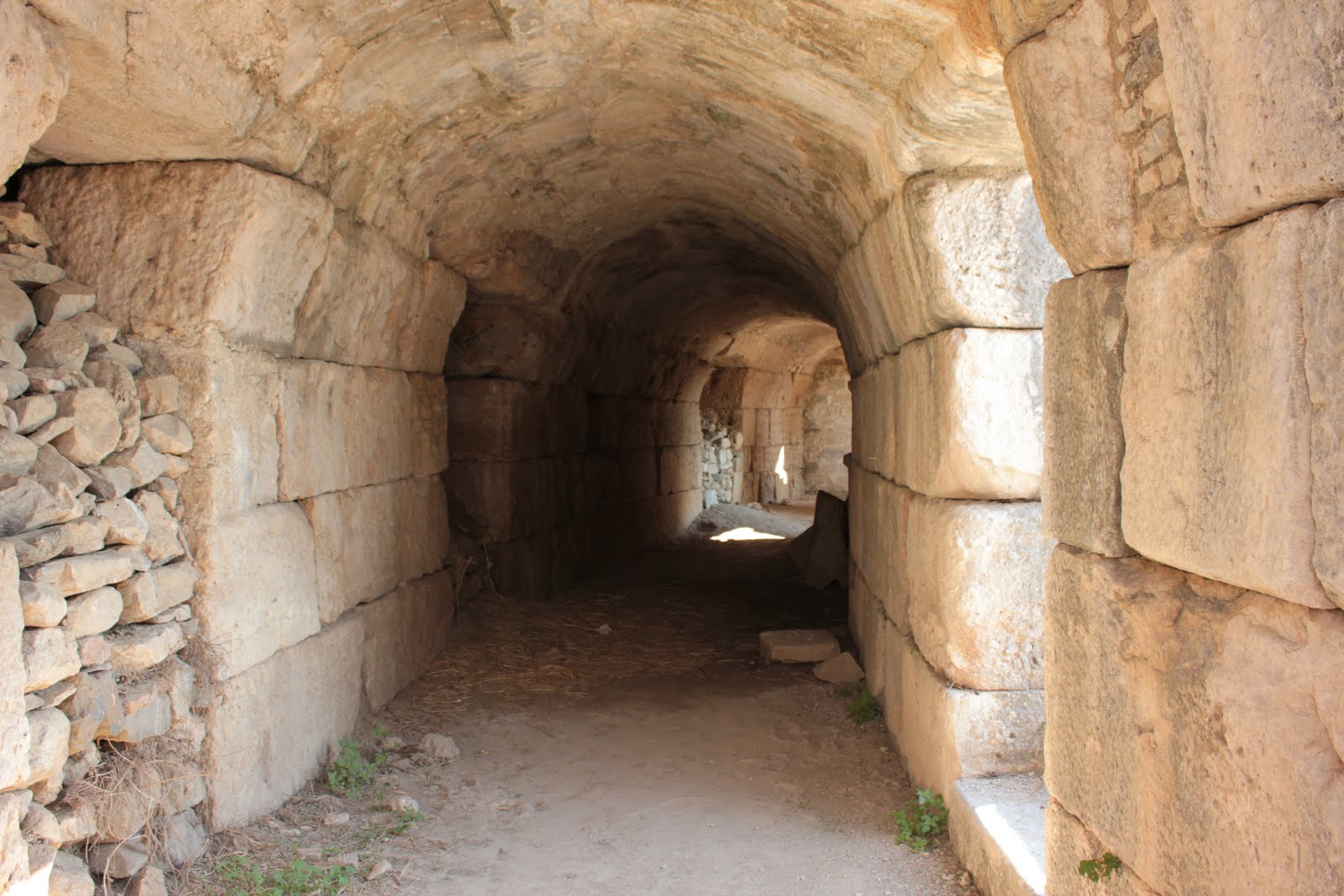
Passages in the back of the theater


Bottom of the theater


Behind the theater - dock house and customs house


Behind the theater - in the background are the baths


Carvings of a hunt
The final city we visited was Didyma, which is actually just a giant temple of Apollo that was unearthed in the 1800s. In 300 BC, when Alexander the Great conquered this area, he wanted Didyma to be rebuilt for the god Apollo; it had previously been destroyed by the Persians. It was never finished, however, and if it were finished it would've been the largest in the world. There is evidence at the site that it was never finished; columns are left uncarved, friezes unfinished.
What remains, however, is amazing! The columns are huge, the finished carvings are beautiful, and it's just such a fun place to explore. In the back of the temple was the oracle's house; there used to be a carbon monoxide well there, so when the priests would ask her a question, she'd “inhale Apollo's spirit” and give an answer.


Temple of Apollo


Column top


So many ruins!!


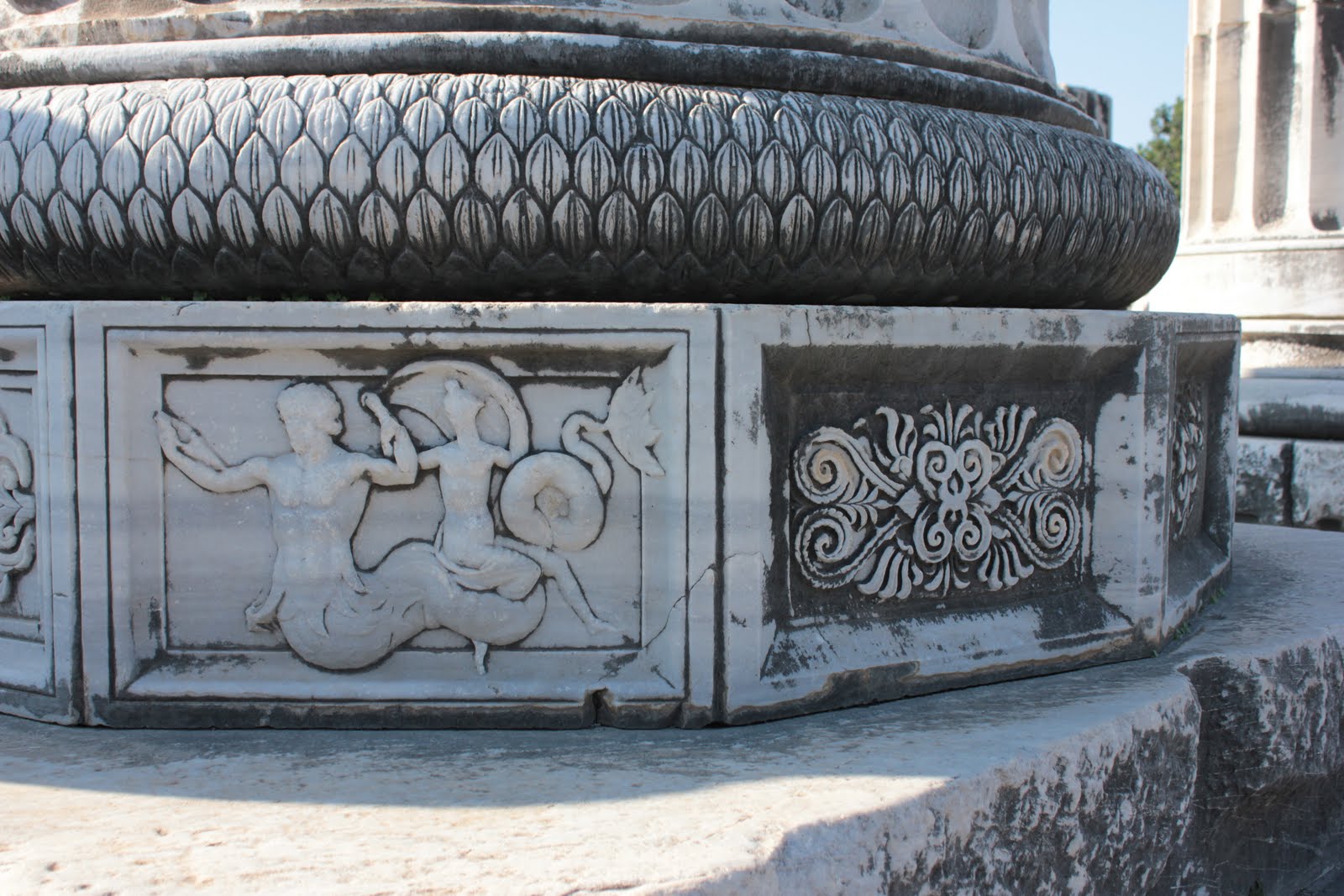
Medusa heads and carved friezes


Giant columns


Back of the temple


The oracle well and a collapsed column