Showing posts with label Church. Show all posts

Saturday, December 3, 2011

Chim-Chimney

It was startling to wake up at 6am on the bus, look out our window, and see Mongolia. Wait, this wasn't Mongolia. After basking in the Mediterranean sun, we weren't really prepared for the landscape that was laid out before us. The brown and yellow rolling hills of Cappadocia (pronounced “Ka-pa-do-kia”) are set against snow-capped mountains that feature prominently in the background. The ground is covered with grasses and bushes that reminded us of the Mongolian landscape. But once we got on the shuttle bus and drove to the town of Goreme (“GO-rem-eh”), and realized we were on top of a mountain looking into valleys of white, pink, and yellow stone, we knew the similarities to Mongolia stopped and the amazing landscape of Cappadocia began.

Day 1

The Goreme Open Air Museum is one of the largest (and easiest to get to) site in the Cappadocia region. This is especially true if you are staying in Goreme (obviously). It is less than 2000 meters from most of the cave hotels. We decided to walk over there shortly after checking in. As with the rest of Turkey, the town is very quiet, because it is low season.

The weather during the day was pretty nice, so the walk was a pleasant one. Unlike Russia, there were signs clearly pointing out the way to the Open Air Museum. For an introduction to fairy chimneys, cave churches, and cave dwellings, the Open Air Museum is a great primer. You will see all of those in about an hour and a half. We discovered that there were better examples elsewhere, but they are a bit more spread out. If you only have a day or two in Cappadocia, the Open Air Museum is worth a visit. If you have a significant amount of time in the region, you could skip it for more interesting examples elsewhere.


Views of one of the many churches.


Inside paintings.


Believe it or not, this is a dining table. They sit on the outside and eat in the middle.

After we left the Open Air Museum, we got a hot chocolate at the museum shop and then headed into town for lunch. There were only a handful of restaurants open, so we chose one that advertised a set menu that included one of Cappadocia's signature dishes: stone kebap. They put a stew-like mixture of meat and vegetables inside of a clay pot and seal it tight. From the looks of things, they put the pot directly into the coals to cook it, and then they break it open when they serve it. That all makes for a fun little presentation during the meal.

After that, we just explored the surrounding area and made note of the things we wanted to do over the next few days.


Stewed goodness.

Day 2

On our second day in Goreme, we decided to book a tour. The hotel calls the tour “Undiscovered Cappadocia.” It is a departure from the normal tour routes people go on. We generally try to avoid tours, but Cappadocia is extremely spread out, and you would need to rent a car (we realized we should have done this) to see everything. The tour covers Mustafapasa (an old Greek town), the Sobessos church excavation site, Soganli Valley, and Derinkuyu underground city. Usually, people go to see a larger valley (that is apparently quite ugly this time of year), the place they filmed Star Wars (should have gone), and the underground city. The tour was in a word, boring.

I try not to mock tours too much, but this one was pretty terrible. Mustafapasa is really just a village. The houses and cave homes have all been abandoned and aren't kept up in the least. Anything that made them uniquely Greek has faded over the last 90 years. The Sobessos church excavation site is actually past Mustafapasa. The church has been mostly excavated, but they are rebuilding the outer wall and the front gates that used to cover the cave entrances. There was heavy construction going on, the air was dusty, and the way in wasn't what I would term safe. Soganli Valley was the first fun thing on the tour, and it came when our day was nearly half over. It was a one kilometer hike past two old cave churches. The cave churches weren't that exciting and we didn't get much time there, but the valley was very beautiful. You could see very distinct lines of mineral deposits in the rock formations.

The underground city made the rest of the tour bearable. It is a remarkable feat of engineering. The underground cities in Cappadocia were basically underground castles. They were used to store food, but they were also used during invasions. Cappadocia was right in the path of the Crusades. The inhabitants of the area could live in these underground cities for up to two months. They created a complicated network of tunnels, rooms, and air ducts to make the city liveable and defensible. We went about 75 meters bellow the surface when we explored the city. We also got to see the air ducts that kept fresh air flowing throughout the entire nine tier city. The air ducts are actually what allowed the cities to be rediscovered. People would find holes that looked like wells, but get no water. Being naturally curious, they would drop a rope down to explore and find entire rooms that hadn't been touched in centuries. The city we visited is the largest open to the public. There was one discovered last year that they think is much larger, but some of the tunnels were built so you could only crawl through them. So there is a question as to whether that city will ever be opened to the public.

So the verdict on the tour is don't do it. Get one of the public buses to the underground city and do it yourself. Make sure you read up on it ahead of time to know what you are looking at, but the rest of the tour is completely unnecessary.


The only interesting thing in the Greek village.


Frescoes with soot covering them and a well.


The remains of another bath house and a mosaic on the floor of an old Byzantine church.


Soganli Valley.


Rooms, tunnels, and hallways in the underground city.


All three of these pictures are of the air duct that ran all the way to the bottom of the city.


Messing around in the morgue.

Day 3

We set aside day three for hiking. We have been traveling for two months now, and through Mongolia and Russia were able to control ourselves food-wise. Well, in Russia, it was really the fact that you paid separately for every little thing that controlled us. In Turkey, the portions are generous, the bread is amazing, and the wine is pretty good. We gained a little weight in the Mediterranean, because that's what you do.

In light of that, we decided to hike two of the valleys. One is called Pigeon Valley. It is a short two mile jaunt through mostly flat land. There are some stone chimneys, tons of pigeon houses (more on that later), and very nice volcanic rock formations. The valley funnels toward the town Ucisar (Uchisar). It didn't take us very long to get to Ucisar where we got lunch.


There were a lot of these short tunnels through the rock formations.


This is a tea house that was completely abandoned.


Screwing around in the canyon.

As we walked toward the town center, pretty much everything was closed. Ucisar is much smaller than even Goreme, which isn't big to begin with. We settled on a restaurant called Lil'a. You could tell by looking in the window that the restaurant wasn't cheap, but it was pretty much the only option. We were glad we chose it. The prices were high for Turkey, but not too high in general. The food was excellent and their standard table wines were very good. We were good and only got one glass each.


Anatolian style beef wrap with veggies, soup, salad, and wine.

After lunch, we were off to Honey Valley. Honey Valley is a little more ambitions, because the valley is just over three miles long, but it lets you out another mile and a half or so from Goreme. We discovered that it is also difficult to find. We went to the onyx factory near the opening to the valley and walked down the road. We walked and walked, but didn't see a place to get into the valley. So we decided to get off the established path and see if we could find an entrance. We later discovered that we were looking off the wrong side of the path. We actually went completely around Honey Valley. Due to this mistake, we probably walked closer to four or five miles without even realizing it. We only figured out what happened when we were on our balloon ride the next day.


The outside of Honey Valley.

We still had fun though, and we were able to meet up with Amanda and Dennis again for dinner at a place called Alaturca. It is in Lonely Planet, so the food is a little more expensive than the standard price, but it is very good. The wine there is extremely cheap. Only 22 Turkish Lira (around $14) for the cheapest bottle. After dinner, we headed over to the mulled wine place again. Nothing beats a warm drink on a cold night.

Day 4

At 6:05AM we left for a balloon ride (see Come Fly With Me...). After we returned, we relaxed and moved into a suite at the Kelebek Hotel (see our review). Emily had a few job interviews with people via Skype. We decided to use the Turkish Bath (hammam) at the hotel after lunch.

The hammam is a two-room bath house. One of the rooms is a dry sauna. The other room is a room to relax in that has a warm stone sitting in the middle with water basins built into the walls on the outside. We were expecting a Korean-style bath house with hot and cold pools of water, but that's not what we got. We had free entry, so it was nice to sit in the sauna for a while, use the basins to bathe, and then just relax on the hot stone. If you weren't staying in a suite though, the price was 10 Euro. There is no way I would have paid that much for the experience we got. They also offer massages, but they bring the cost up quite a bit, so we didn't partake. The bath was still very beautifully decorated, even if it wasn't really worth the money.

After a whole day of doing basically nothing we met up with Dennis and Amanda again for dinner. We took the advice of the hotel and went to the Setin Restaurant next door. They serve Anatolian food and wine. I got lamb shank and Emily got stuffed squash blossoms. Both dishes were very good. Amanda and Dennis got Turkish ravioli and stuffed chicken respectively. They let us try some. The stuffed chicken was delicious. The ravioli was better than the version we had in Kas. Setin's version wasn't as thick.

After dinner, we went back to the suite, started a fire (yes there was a fireplace), took a bath, and went to bed. The perfect end to our Turkish adventure.

Monday, November 14, 2011

The Last Station

Saint Petersburg was the last stop on our Russian adventure. My friends who had previously lived in Russia told me it was the most beautiful city Russia had to offer. It didn't disappoint. Despite the fact that we saw a swastika within the first five hours (Neo-Nazism is alive here), we had a wonderful time.

Saint Petersburg is the cultural center of Russia; bursting with cafes, high end restaurants, designer boutiques, and theaters. It is also home to some of the best museums we have been to. That includes that massive Hermitage, which I will write about shortly. After the rather gray city of Moscow, Saint Petersburg was a welcome breath of fresh air.

Day 1

We took an overnight train from Moscow, which meant we arrived at 8AM. We got to our hostel around 9AM, but we weren't able to check-in until around 1PM. So, we stored our backpacks and relaxed in the lobby until around 11AM. We were getting bored of watching Russian dubbed American television, so we decided to go out and explore a little bit.

We went to a coffee shop, where surprisingly the waitress spoke English. We encountered very, very few English speakers in Moscow. Afterward, we wandered down a pedestrian street. We ran into one of the many parks in Saint Petersburg, and quickly found ourselves at the Russian Museum. We didn't end up going in, because it is filled with European art, and we were only a day away from going to the Hermitage, which has enough art to keep anyone occupied for a few days.


The Russian Museum exterior.

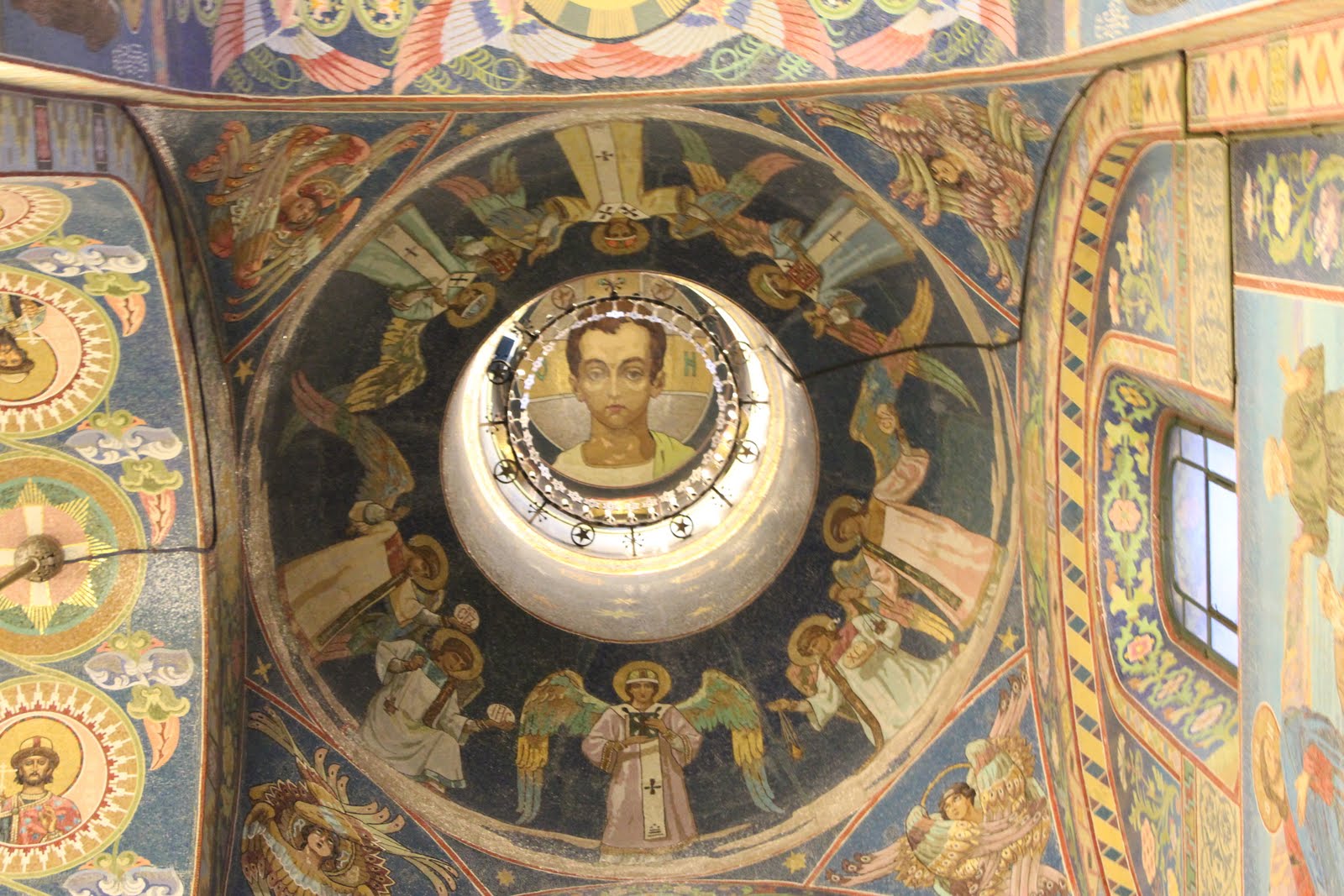
As we walked through the park – which we later found out were gardens attached to massive palaces - we saw a very beautiful church at one end. I was nearly church-ed out by the time we got to Saint Petersburg, so I wasn't too keen on walking that direction, but Emily insisted. It turned out that it was The Church of Our Savior on Spilled Blood. That is one of the premier attractions in Saint Petersburg, and a sight we were going to see anyways. Upon entering the church, we were immediately glad we did. Unlike other churches around Russia, which feature extensive paintings of icons, these icons were all mosaics. They give the church a unique visual appeal. It is popularly known as the church that took 24 years to build and 27 to repair (after World War II).


This is what we saw from the gardens.


Mosaics and the ceiling.


A mosaic like this is inside each dome.

For dinner, we had cafeteria-style Russian food. Not like school food; this is a common style of restaurant in Russia where everything is displayed in front of you and you point to what you want. It's fun to get a variety of things at a very cheap price. Mostly they have salads, soup, various meats and then potatos, rice, barley, or pasta as a side. Most places have draft beer, wine, and desserts. It's the only cheap way to eat Russian food.

Day 2

The Hermitage is easily the biggest sight in Saint Petersburg. It is a massive, multi-building museum that houses an extensive collection of 19th century housewares, paintings from all over Europe, a small medieval and Renaissance arms collection, and of course religious iconography. It is a museum like the Met, but on the scale of the Smithsonian. We knew that it would be an all-day affair, so we headed out a little early to beat the rush.

The museum opens at 10:30AM, so we got there around 9:45. We were near the front of the line, which was already forming. By the time 10:30 rolled around, the line was getting quite long. So, if you want to visit the Hermitage, buy a ticket ahead of time online, or get there at least a half hour before the museum opens in the off-season. I'm assuming you would have to get there much earlier during peak tourist season.

The museum was formerly the winter palace for Tsar Peter the Great. It was turned into a museum in the mid-1700s by Catherine the Great. I could write pages about the various paintings and rooms, but we were most impressed by the rooms of the palace that had been preserved, many of the palace decorations, and a couple of exhibits that are tucked away.


Two of the five Hermitage buildings. The main building is on the left


This is a painting of one of the women in War and Peace.

The first of these exhibits was comprised of items from the 7th - 6th centuries BC that were found in Siberia. They include a nearly perfectly preserved horse and various well-preserved pieces of clothing, hair, and tools. The next exhibit was from a city found along a detour in the Silk Road. It was a village that bought and sold silks from the Middle East, China, and Persia. Because silk was their main trade, the people of the village wore it as everyday clothing. Many of the pieces look like royal clothing, which is remarkable considering the village was poor. The dry conditions in the area helped preserve some of the extremely valuable silk. That is how they connected the village to the Silk Road trade route. Both of these exhibits were a bit difficult to find. We went downstairs from one of the many European art galleries and came face to face with a corridor full of boxes. We saw that there were exhibits behind the boxes, so we decided to just keep walking through. We eventually found the exhibits. I wouldn't be surprised if more than one person skipped them though, because some of the staff was standing about casually and the doors were left open.


This used to be a horse.


One of the preserved palace rooms.


Some of the more famous large paintings. Yes, that is a baby seal at a fishmonger.


Arms and armor.


This wasn't the most impressive hallway we saw.


Emily dancing in an unnamed ballroom.


This is a clock. Seriously.


Main throne room.


Itty bitty throne room.

The rest of the museum is impressive, but nothing you wouldn't see in a place like the Louvre or the Met. The only other things of note would be the two rooms dedicated to Picasso and one room dedicated to Matisse.

After over five hours at the Hermitage, we got a very late lunch around 3:30. After that we wandered around a little bit and decided to take a look at the Russian Vodka Museum. It is only a few rooms, but it gives you a quick rundown behind the history of vodka. After, you can do a three glass vodka tasting with a few Russian snacks thrown in. Not a bad stop, and it only takes about 40 minutes. We tried Russian Standard, Russian Standard Platinum, and Imperial vodkas. Our snacks were not as good: a pickle, pickled herring and onion on bread, and white fish and mustard on bread. Emily did not like them, although they are traditional vodka snacks.


Meet the man behind many a hangover. He is Mr. Smirnoff.

Day 3

Today we crossed the main river (Neva) that runs through St. Petersburg. We made the trip to the Political History Museum, which was a pretty big disappointment. The museum used to be a famous ballerina's house. It was taken over by prominent members of the Communist party, it's where Lenin gave many of his speeches, in 1917. The layout is a little confusing, and we found out we missed half the museum when we were leaving. If the museum were laid out better, or if there weren't so many closed hallways, we would have probably had a better time. Emily felt it was a waste because we didn't see what we went there to see: Soviet propaganda posters.


Crossing the Neva.

After that, we made our way over to the Peter and Paul Fortress. Entrance is free anytime, but you have to pay to enter any of the buildings or to go on the battlements. We opted for the free stuff and loved it anyways. The fortress is right on the water, so you can step outside and take a walk outside the walls on the beach. The fortress is also home to the Peter and Paul Cathedral that has a 122 meter spire. Since the fortress was the city's original citadel, it is worth seeing.


Yet another penis measuring contest won by Russia.

We decided to hit a local spot we found in Lonely Planet, because it sounded hilarious. It is called Russian Kitsch, and it is definitely heavy on the kitsch. There are seven themed rooms that are all over-the-top. The only way to really know what we're talking about is to experience it.


Not even a fraction of how kitschy the place really is.


Our last sunset in Russia.

Day 4

On our last day before we headed to Istanbul, we made it to two more sights: the Leningrad Blockade Museum and the Zoology Museum (See “Lions, and tigers, and bears...”).

The Leningrad Blockade Museum was one of our favorite Russian Museums. It is really only a single room, so you won't miss anything, but the layout is the best part. The outside walls house the military portions of the museum. In the center, they have the civilian portion of their collection. It is a clever nod to the way a siege works. The blockade of Leningrad by Germany was one of the defining moments of World War II for the Soviets. The museum does a great job illustrating this fact. They call the Germans fascists, not Nazis. It's an important insight into the way Russians study Nazi Germany. They do a good job outlining the military aspects of the siege in a way that isn't boring for non-history types. The museum also illustrates the way life goes on during wartime. Children still went to school, they still held sports competitions, and they even held a symphony orchestra concert. Aside from the Hermitage, this is the one museum in Saint Petersburg I would see.

Day 5

We got on a plane for Istanbul, but not without two pretty good stories. Both of these happened at the airport. First, we discovered that after St. Petersburg-ians get married and have their reception, they go straight to the airport in their wedding attire. We saw one of the drunkest brides either of us had ever seen. We will call her, Drunk Bride. When drunk girls say they are falling out of their tops, they're usually joking. Drunk Bride actually came out of her dress more than once. You usually have to buy a Girls Gone Wild video to see that. She also fell on multiple occasions, tripped over her dress, tripped over her suitcase, tripped over her husband, and in general had a difficult time staying upright. After she disappeared into the check-in room, we didn't see her, but we thought about following her to see what might happen. Thank God she wasn't on our flight!!

After we finally got in line to check-in, we saw a fight between a Turkish man and a Russian man unfold. This had to happen in the line we were in, of course. We really started to notice it when the two men started raising their voices. That escalated into a little shoving, and all of a sudden multiple people were separating the two men and security was showing up. We don't know any of the details, but women were crying and the men were pointing and yelling. In the end, everyone got checked in and everyone got on the plane. It couldn't have been too serious.

So goodbye Russia, and hello Turkey!

Monday, October 24, 2011

Journey to the Past

For those of you who are animated movie buffs (or girls, for that matter), you may recognize the title from the 90s movie, "Anastasia", a cute song-and-dance movie about the last remaining Russian Romanov, Anastasia. Today we got to visit the city where they were presumably murdered, Yekaterinburg.

According to the Lonely Planet Russia guide, they tested the bones of the Romanovs in the 90's - Anastasia's was with them. Turns out it was another daughter who was not accounted for. Sucks for the movie :(

Church of the Blood, where the Romanovs were killed. Monument to the Romanov family.

Anyway, Yekaterinburg is a lovely city with most of it's historical center spread out over many blocks. It's a modern city with trams, trolleys, and buses connecting all corners. There are a plethora of pubs, bars, restaurants, cafes, and shopping centers (even a Gucci!). It feels like the first cosmopolitan city we have hit since we left Seoul.

In the center of Yekaterinburg is the City Pond, created by a dam. Around the pond are some nice parks including Lover's Lane and the Keyboard Monument, a walking path, and the Governor's Mansion. And what Russian city would be complete without it's statue of Lenin!

City Pond and Lover's Lane


Keyboard Monument and Lenin

We walked around for 3 hours admiring the sights, architecture, streets, and people before we hit the post office (see previous post). Our favorite church, among a dozen, was the Ascension Church. From the side it was a beautiful sky blue and white, with gold towers. From the front it was old and peeling; obviously it hadn't been restored yet!

Side and front view of Ascension Church

Yekaterinburg is a good city to stop in for a day along the Trans-Siberian. We liked the history behind the city and the sights it had to offer. We also liked how walkable everything is. If you get a chance to visit you'll enjoy yourself.